Connection · 7 min read
Why Real-World Connection Matters: What the Research Says
We are more connected online than ever, and often less together in person. What recent global research says about social connection, and the everyday habits that help.
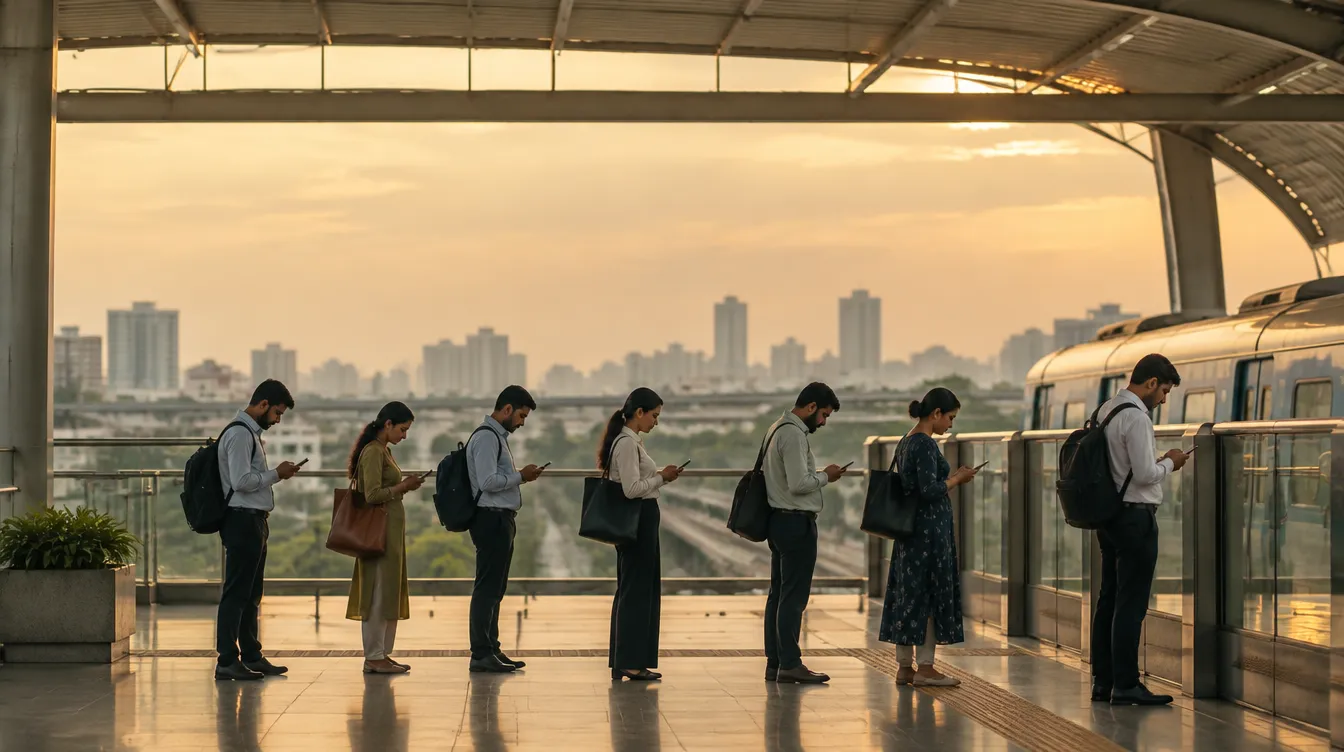
Stand on any metro platform in Hyderabad at half past eight in the morning and you will see the same scene repeated down its length. Dozens of people, a few feet apart, each looking at a screen. Messages are arriving, feeds are refreshing, group chats are busy. Almost nobody is talking to the person beside them.
None of this is a failure of character. Phones are useful, and many of those screens are full of real relationships with family in another city or friends from college. But it does capture something about the way many people live now. We have never had more ways to stay in touch, and yet the simple experience of being in the same place as other people, doing something together, has quietly become less common.
Over the past few years researchers have started to measure what that shift means. The findings are worth knowing, not because they are alarming, but because they point to some surprisingly ordinary things that help.
What the World Health Organization found
In June 2025 the World Health Organization published the global report of its Commission on Social Connection, one of the most comprehensive looks at the subject so far. Its headline findings were stark. According to the WHO report:
- 1 in 6 people worldwide is affected by loneliness.
- Loneliness is linked to an estimated 100 deaths every hour, which is more than 871,000 deaths a year.
- Young people are not exempt. Between 17% and 21% of people aged 13 to 29 reported feeling lonely, with the highest rates among teenagers.
- Income matters. About 24% of people in low-income countries reported feeling lonely, roughly twice the rate in high-income countries, which was about 11%.
- Social isolation is widespread. It is estimated to affect up to 1 in 3 older adults and 1 in 4 adolescents.
It helps to be clear about the two terms. Loneliness is the painful feeling that your connections are fewer or less close than you would like. Social isolation is the objective state of having few relationships or little contact with others. They often overlap, but a person can be surrounded by people and still feel disconnected, or live quietly and feel perfectly content.
Why it matters for health
The WHO report is careful to frame social connection as a health issue, not only a personal one. It notes that loneliness and isolation increase the risk of stroke, heart disease, diabetes, cognitive decline and premature death. It also reports that people who are lonely are twice as likely to get depressed, and that loneliness can lead to anxiety.
The other side of the picture is just as important. The same report found that social connection can reduce inflammation, lower the risk of serious health problems, foster mental health and prevent early death. In other words, connection is not a nice extra once everything else is in order. It belongs on the same list as sleep, movement and food.
Online contact and in-person contact are not the same thing
Much of modern social life now runs through screens, and that has real benefits. It keeps families close across distance and makes it easier to find people who share an interest. But research suggests that being physically present with others still holds a particular place in how people connect.
The Meta and Gallup State of Social Connections study surveyed at least 2,000 people aged 15 and over in each of seven countries, Brazil, Egypt, France, India, Indonesia, Mexico and the United States, between April and June 2022. Across those countries, in-person interaction was the most frequently reported way people connected with others. The study also found that people with larger social networks tended to feel more connected.
That second point is easy to overlook. Feeling connected is not only about one or two close relationships. It is also about the wider web of people you see, recognise and exchange a few words with.
What actually helps
None of this requires a dramatic change in how you live. The habits that support connection are mostly small, repeatable and a little unglamorous.
Regular in-person contact
Frequency tends to matter more than intensity. A short coffee every week does more to keep a relationship alive than an elaborate plan every few months. If you have friends in the city, a standing arrangement, the same day and the same place, takes away the effort of planning every time.
Shared activities
Sitting across from someone with nothing to do but talk can feel like an interview. Doing something side by side is easier. A walk through a market, a meal, a class, a game of cricket in the park. The activity gives the conversation something to lean on, and silence stops feeling awkward when there is something else to look at.
Weak ties
Researchers sometimes use the phrase weak ties to describe casual acquaintances: the café owner who remembers your order, the neighbour you greet on the stairs, the person at the bookshop who recommends something every time. These relationships are light, but they add up. They make a city feel familiar, and they are part of that larger social network the Gallup study described.
Routines and familiar places
Going back to the same places is one of the simplest ways to build weak ties. Become a regular somewhere, at an Irani café, a bakery, a weekend market, and the city slowly starts to recognise you back. Our guide to things to do alone in Hyderabad has a few starting points.
Community
Groups built around a shared interest, such as running clubs, book circles, volunteering or a neighbourhood association, give you a reason to show up repeatedly without having to invent one. If you have recently moved, our piece on how to make friends in Hyderabad goes into this in more detail.
Why this is harder than it sounds
Knowing what helps is the easy part. Many people move cities for work, and arrive without the school friends, cousins and old neighbours who once filled their week. Long commutes eat into evenings. Remote and hybrid work can mean entire days without a face-to-face conversation, something we touched on in our guide to working remotely in Hyderabad. And for many people, the hardest step is simply leaving the house with a plan.
That is worth saying plainly, because it means the problem is often practical rather than personal. When the barrier is logistics, small structures help: a fixed time, a specific place, an activity with a clear beginning and end.
Where Meezoy fits
Meezoy is one modest way to add that kind of structure. In Hyderabad, you can book a verified Local Partner by the hour for a real activity, Coffee, Food or Shopping, at a Meezoy Verified Spot, which is always a public place. Local Partners go through ID verification and review before they are approved, and payments and chat stay inside the app. You can read more about what a Local Partner is and how our safety approach works.
Every booking follows the Experience Promise: booked for the activity and only the activity, public spots always, and respect and boundaries both ways. It is not a substitute for friendship or community, and it is not meant to be. It is simply a way to get out, share an hour of something you enjoy, and learn a little more about your own city from someone who knows it.
A small, steady practice
The research on social connection can sound heavy, but its practical message is light. Show up in person when you can. Do things alongside other people. Learn the names of the people you see every week. Go back to the places you like. None of it is complicated, and all of it compounds over time.
The metro platform will probably always be full of people looking at their phones. But every so often, someone looks up and says something to the person beside them. That is usually how it starts.
Now in Hyderabad.
Coffee, food and shopping with verified Local Partners.